
 HOME
HOMEFormer Chairman’s Message
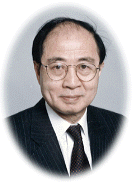 Since the end of the Cold War, the world has been confronted with the enormous challenge of regional conflicts taking place among a variety of ethnic, linguistic and cultural groups. In dealing with such conflicts, UN peacekeeping activities during the 1990s proved to be successful in some cases, but revealed their limitations in others. UN Secretary-General Kofi Annan questioned the validity of the widely held view that poverty causes conflict. He pointed out that inequality among social groups and unequal access to political power, were also critical factors.
In order to prevent such regional conflicts from occurring and to forestall terrorist activities in the aftermath of 9/11, a renewed stress has been laid in recent years on the importance of conflict prevention. To this end, the international community has to adopt an integrated approach encompassing political, economic, environmental, social and developmental policies based on the UN Charter, the rule of law, democracy, social justice and full respect for human rights. Conflict prevention mechanisms require a variety of measures, depending on the evolving stages of conflict namely: (1) the stage of conflict prevention before violence erupts; (2) the early warning stage; (3) the stage of breakouts of conflict; and, (4) the peace agreement stage. In stages (1) and (4), the role to be played by NGOs is particularly important.
Difference in living standards, social discrimination, political inequality, insufficient democracy, disregard for human rights etc may be considered long-term causes of conflict. Civil society organisations, rather than governments, are in a better position to deal with such indirect causes of conflict. The role to be played by NGOs is also important after a peace agreement has been reached in carrying out rehabilitation, reconstruction and facilitating free elections for the establishment of democratic government. In order to eradicate conflicts and terrorist activities, sustained efforts and cooperation are required among a wide range of actors such as states, inter-governmental organisations and NGOs. As one NGO actor, the Japan Center for Conflict Prevention aspires to make its modest contribution.
Yasushi Akashi