| Weapons Outlive Conflict
It is a widely recognized fact that small arms kill. It is estimated one person every minute or half a million people die as a direct result of small arms. It is also estimated that there are over 550 million small arms in circulation across the world at this time, one for every 12 people.
An opening line from the recent Hollywood Blockbuster “Lord of War” – the fictional tale of the arms trade based on a real arms dealer – poses the question of how to arm the other 11. Although this makes for a light, slightly unexpected stance for the movie’s opening sequence, it is the antithesis of a global campaign to reduce arms and implement and Arms Trade Treaty (ATT).
The “Control Arms” campaign, run jointly by Amnesty International, IANSA and Oxfam recently made its debut in Tokyo at an international symposium organized by Oxfam Japan. I had the pleasure of speaking with two of the speakers following the symposium 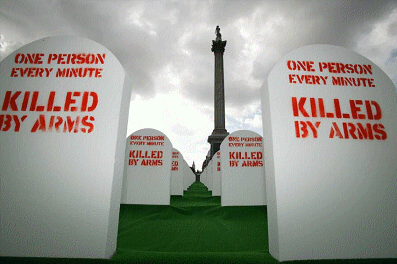 | Dr Michael Ashkenazi, a consultant with the Bonn International Centre for Conversion, points out during the course of our conversation that the quoted figure for small arms is just an estimate. Nobody knows how many small arms are in circulation throughout the world and until there is some internationally recognized and applied way to control their distribution we will never know.
As someone with both a military and academic background and currently producing training materials to educate others about small arms, Dr Ashkenazi knows his stuff and takes a practical, pragmatic stance on dealing with the trade in arms
Whenever one broaches the issue of an Arms Trade Treaty(ATT) one is immediately confronted with both moral and practical considerations. On this Dr Ashkenazi is quick to point out that whilst governments agree with the idea of reducing arms, so long as it washes with the voters, most governments, in fact most parties to an ATT, would have vested interests. When it comes to negotiation each party will try to gauge as many concessions as it can, it will try to protect as many of its interests, or the interests of those it represents, and the result will be a treaty without teeth.
What is necessary is to make it a commercial issue so it directly affects profitability and financial incentives. As is the case with chemical transportation which has strict rules and liability requirements, “Once you make something a commercial issue” Dr Ashkenazi continues, “then all of a sudden industry sits up and takes notice.” Yet an ATT should extend past merely transportation and address the issue of the marking and tracing of weapons. Dr Ashkenazi sees marking and tracing as potentially the single biggest problem for an arms trade treaty (and that is hardly considering the 550million or so arms already in existence). “Marking is making sure every piece of weaponry has a unique identifier code. Manufacturers have argued for years that this costs then a bomb, they can’t afford to do it etc., etc. Other manufacturers … simply don’t bother. We know of at least one series of weapons that are marked with the same serial number, 10,000 guns all with the same serial number!” Tracing, he says, is a social institution with the problem coming down to weapons going from places they should be legally, to places they shouldn’t be.“[Weapons] bleed out of unprotected armories, they are stolen, they are given away by police, by military personnel, they are left on the battlefield when someone runs away, and we have, quite often, no way of knowing if someone is shipping in new stuff until they turn up on someone’s doorstep”.
Ms Afi Yakubu, the other international speaker at Oxfam’s symposium and Associate Director of FOSDA, the Foundation for Security and Development in Africa, is an avid campaigner for an ATT and gave this example to show the importance of tracing and the necessity of an ATT.
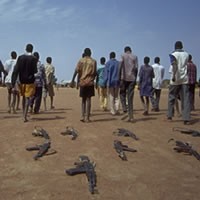
“Weapons outlive conflicts. Weapons that were used in the 1960s, during the Guinea-Bissau uprising for independence, were found in the Liberian conflict. The same weapons were also found in the Sierra Leone conflict, the same weapons were found in the Casamanche, in southern Senegal. And the same weapons are now in Cote D’Ivoire. … it is a common thing that happens in West Africa. All the conflicts have been visited by almost the same stock of weapons and if they could easily be marked and traced that would really address the problem.”
But it is not only in conflict situations that weapons are harming development in Africa, local policing and (petty) crime are also affected. Ms Yakubu told a story of recalcitrant officers who had hired their weapons out to armed robbers on multiple occasions and Dr Ashkenazi told of on one trip to an unnamed African country seeing policemen walking around with empty holsters. On asking his guide, a government official, why, he received that answer that police could not be trusted to keep their guns as they rent them out to criminals at night. In order to prevent this they gave one gun to a 3 man patrol in the hope they would be so envious of one another no-one would be able to get away with renting the gun out without being told upon.
It has to be a sad state of affairs when this sort of event occurs on a regular basis but even sadder when those with the power and ability to do something don’t, often for financial reasons.
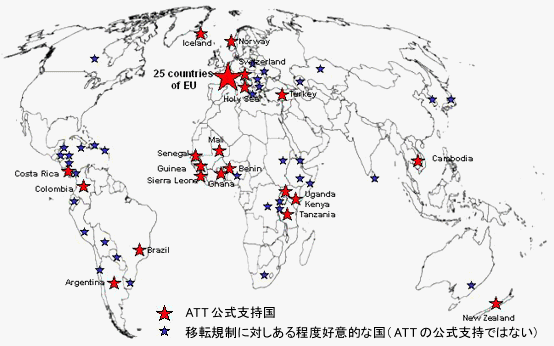
 | But it is not all doom and gloom, progress is being made in West Africa and they are showing they can do it alone. The Economic Community of West African States (ECOWAS)> implemented a moratorium, which by its definition is voluntary, on the proliferation of small arms and light weapons, munitions and other related material, that includes a provision for tracking and marking weapons as well as a provision for countries importing weapons to notify the ECOWAS secretariat.
Ms Yakubu, whose organisation is lobbying to make the moratorium legally binding, told me how successful the moratorium had been thus far on increasing transparency and making steps towards controlling the flow of arms in West Africa. To the extent that even supplying countries now write to the ECOWAS secretariat asking for clearance to sell weapons to countries in West Africa.
However, the weakness of the moratorium rests in its lack of legal status and consequent absence of provision for penalty. Ms Yakubu and many others are hoping the ECOWAS heads of state will hear theirs calls and do something about this soon. Ms Yakubu hopes that one day in the not too distant future when a campaign is organized in West Africa to control arms it will gain support and backing from across the globe. The more people behind a campaign and the more international organisations providing their support the greater the weight of the campaign and the more likely we are to get results and get them soon. The first meaningful Arms Trade Treaty could already have its foundation in the ECOWAS moratorium. So what can you or I do in the meanwhile? Whilst one can always donate to charitable organisations or volunteer one’s time and this is always helpful, so is education. If one can educate oneself on the problems and solutions for small arms it opens up opportunities to educate others and show your support in other ways. The Control Arms campaign is currently running a “Million Faces” campaign. Check it out on their website and put your face up there to show your support. http://www.controlarms.org/ or http://www.controlarms.jp/index2.php for the Japanese site.
|