| a) An Interest in Preventive Diplomacy
The history of JCCP begins with the three-year period when it was called "The Japan Center for Preventive Diplomacy (JCPD)". Prior to that, there was another three-year period when JCPD’s foundations were laid by the research activities of "The International Study Group on Preventive Diplomacy (ISGPD)" organized by "The Japan Forum on International Relations (JFIR)". It was JFIR that gave birth to and fostered JCPD. JFIR is a policy-oriented think-tank concerned with international and diplomatic issues. Since its establishment, the maintenance of world peace has been an important focus of its interest. In fact, in October 1992, JFIR published a policy recommendation, "The Strengthening of the U.N. Peace Function and Japan`s Role". However, at that time the term "conflict prevention" was seldom heard, and the use of the term "preventive diplomacy" was limited to specialists only. In 1996 Iriyama Akira, President of The Sasakawa Peace Foundation, suggested to Ito Kenichi, President of JFIR, that it was advisable for Japan to conduct in-depth research into what was then called "preventive diplomacy". The two men joined forces to set up ISGPD within JFIR. Donowaki Mitsuro, former Ambassador to the Conference of Disarmament, was inaugurated as the chairman and under his guidance ISGPD conducted such activities as sending field missions to hotspots in Asia-Pacific, Europe and Latin-America and holding international symposiums in Tokyo, Washington and Beijing. The conclusion of the Group’s final report recommended that "Japanese people also should play an active role on the world stage in the field of preventive diplomacy".
b) Steps towards the Establishment of JCPD
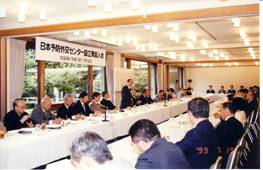
However, as it is often the case, the Group’s recommendation attracted attention only from specialists and experts. It was difficult to expect someone to come out and say, "Understood! Let me take an initiative!" Ito recalls in his memoir contributed to "JCPD’s Annual Report of October 2000" as follows; "I cannot forget what occurred on 18th February 1999. I had decided to walk home to Yoyogi-Uehara from my university in Aoyama in order to get some exercise. As I was walking through Yoyogi Park, I heard a voice like a heavenly revelation. It said: "If nobody else is going to do it, why don’t you do it yourself?" Being a policy-recommending body, JFIR has made many recommendations, but, needless to say, not all of them have been adopted. The majority of them have not progressed beyond the point of being announced. However, this time I thought I should not let this one go on like that. If nobody else is willing to take an initiative, I should act myself. Though this is a ball I have thrown, if nobody is going to catch it, I must run ahead of the ball and catch it. Upon returning home, I took a pen and wrote in a single stroke "A Proposal for the Establishment of the Japan Center for the Promotion of Preventive Diplomacy" (at this stage the word "Promotion" was inserted). | | | The Founding Meeting of JCPD on July 19, 1999 |
Subsequently, the late Obuchi Keizo, the then Prime Minister, provided invaluable support for the realization of this proposal. Obuchi was one of the leading members of the Board of Directors of JFIR and was devoted to its cause, but he had not had a direct connection with ISGPD. Because of this, Ito assumed that he would have to explain to Obuchi about the concept of "preventive diplomacy" when visiting him at his Official Residence. But this concern proved to be unfounded. When he was a foreign minister, Obuchi had made a speech at the U.N. General Assembly, in which he had appealed to the world about the importance of preventive diplomacy. The two men found they were of the same mind. When Ito said that it would probably take a year to complete necessary preparations for launching JCPD, Obuchi replied that preventive diplomacy was so important for Japan that he wished to see the activities of JCPD to start as soon as possible. After leaving the Prime Minister’s Official Residence, on the same day of 30th March, Ito went to the office of Takemi Keizo, Parliamentary Vice-Minister for Foreign Affairs. In the middle of talking to him, Takemi’s mobile phone rang. Takemi was saying things like "As a matter of fact, Prof. Ito is here at the moment" and "Yes, I understand. So this is an instruction from the Official Residence". Only ten minutes after speaking with Ito, Obuchi had called the Ministry of Foreign Affairs.
c) Founding Meeting
Of course, however, JCPD was to be established as a private NGO, independent from the government. Therefore, its establishment was never possible without the cross-sectoral support and participation of many such private entities as NGOs, foundations, corporations and individuals. Funding pledges from The Sasakawa Peace Foundation, The Risho-kosei-kai Peace Fund and The Arigatou Foundation, and the corporate membership of sixteen companies, including Nippon Steel Corporation and Omron, enabled the launch of JCPD to go ahead. The Founding Meeting for the establishment of JCPD was held in Tokyo on July 19th, 1999. Akashi Yasushi, former Under Secretary-General of the U.N., was elected Chairman, and Ito Kenichi President and CEO. While Article 1 of the JCPD’s Charter stipulated: "The formal title of this Center shall be ‘The Japan Center for Preventive Diplomacy attached to the Japan Forum on International Relations, Inc’. However, the title ‘The Japan Center for Preventive Diplomacy’, hereafter referred to as JCPD, shall be the commonly used title," Article 5 stipulated: "Although in formality JCPD is an organization attached to JFIR, in practice it shall be run as much as possible in accordance with the principles of self-governance and self-finance." As JCPD’s activities expanded at home and abroad, Asomura Kuniaki, former Amabassador to Vietnam, was elected Executive Director at the Board meeting in February 2000. JCPD’s activities further continued to develop and on 28th February 2002 it obtained a legal Non-Profit Organization (NPO) status from The City of Tokyo. From that day onwards, JCPD became independent from JFIR and, accordingly, adopted a new name of "The Japan Center for Conflict Prevention (JCCP)." JCCP had entered a new historical stage of its development.
|